
Lincoln County Projected Release Meaning
Idaho’s public corrections interface does not label a field “Projected Release Date” or “Tentative Release Date.” It displays Parole Eligibility Date and Sentence Satisfaction Date on applicable active records. Those labels answer different questions. Parole eligibility marks when consideration becomes available. Sentence satisfaction concerns the endpoint in IDOC’s current calculation. Neither proves the date or time that a person will walk out.
A pretrial Lincoln County detainee generally has no computed prison release date. Bond, recognizance, dismissal, a warrant, a detainer, and later court action can change custody. The person may also leave the Sheriff’s Shoshone holding location for an out-of-county contract jail. That departure is a transfer, not release to the community. Ask the Sheriff which agency physically held the person and which record contains the actual exit.
Find Lincoln County Projected Release
Begin with the case type. A short county matter, state felony sentence, federal sentence, and immigration hold use different systems. For IDOC, the Resident/Client Search accepts at least two letters of a last name or the first three digits of an IDOC number. Results show IDOC number, name, birth year, and status. Active details may show the sentencing county, case number, Released to Supervision, Sentence Satisfaction Date, and Parole Eligibility Date.
- Collect the full legal name, birth year, case number, arrest date, and IDOC number if known.
- Check the Lincoln case through iCourt. Read the judgment, amended judgment, commitment, bond, dismissal, or probation order.
- For a state felony case, search IDOC and match the IDOC number, birth year, sentencing county, and case number. Do not rely on the name alone.
- Copy the official field label and date. Keep Parole Eligibility Date separate from Sentence Satisfaction Date.
- If parole is involved, review the Commission schedule and decision, then check the later IDOC status for actual movement.
- For a county case, call the Sheriff at 208-886-2250, identify the holding jail, and request that jail’s calculation or release entry.
A Lincoln-only jail case may never appear in IDOC. No result is not proof of release, and a vanished county name may reflect transport to a contract jail. The Lincoln County Sheriff’s Office booking-and-holding facility page explains that local custody path.
Idaho Release Date Fields
The public detail must be read in context. “In custody” means IDOC retains jurisdiction in a custodial placement. “In community” commonly indicates active felony probation or parole and may identify a supervising district. A result reading “Discharged” with a date is the clearer terminal evidence that the state sentence was satisfied. Discharged rows remain visible, but IDOC says conviction detail for the satisfied sentence does not appear.
| IDOC field or status | What it supports | What it does not prove |
|---|---|---|
| Parole Eligibility Date | Date parole consideration becomes available | A grant or physical release date |
| Sentence Satisfaction Date | Current calculated sentence endpoint | An unchangeable exit date |
| Released to Supervision | Most recent placement on supervision | Full discharge from the sentence |
| In community | Active IDOC community jurisdiction | Sentence completion |
| Discharged with date | Satisfaction of the IDOC sentence | Resolution of another case or hold |
The official IDOC active-detail format demonstrates where sentence fields appear.
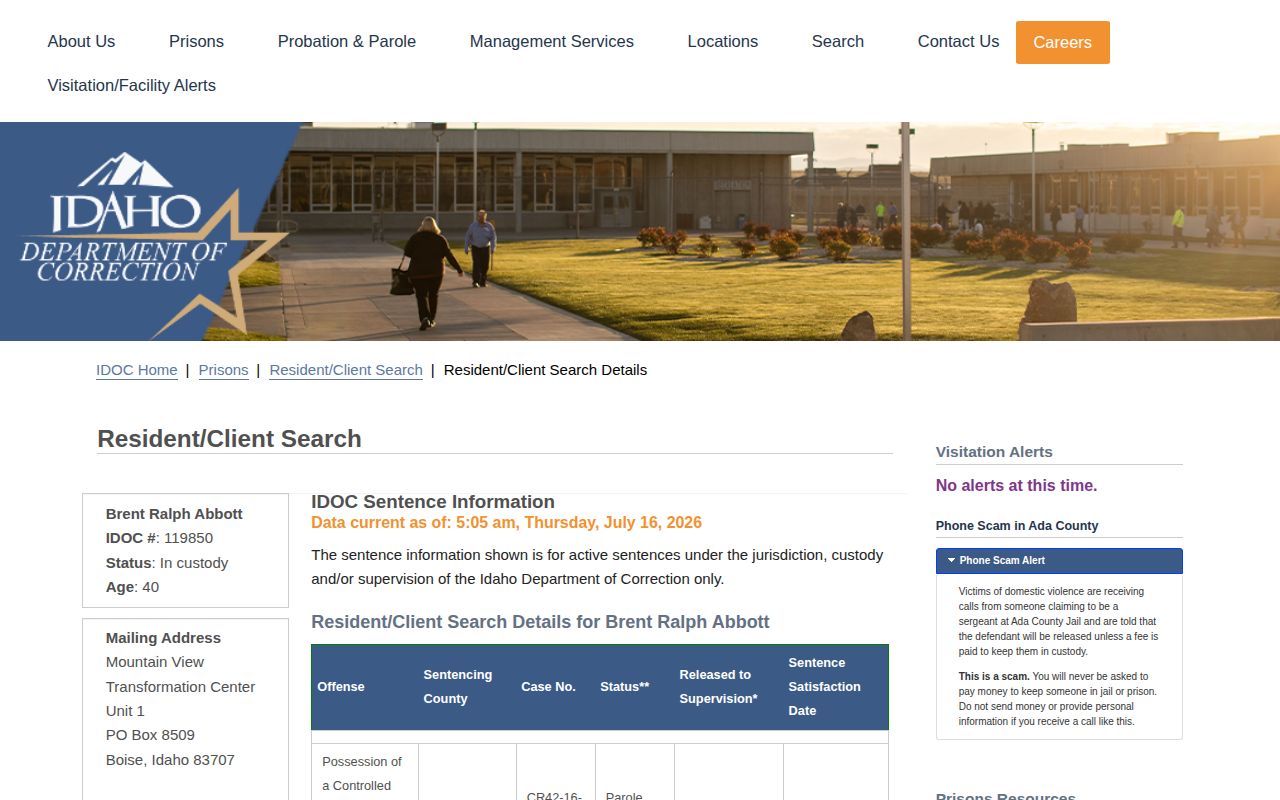
The visual distinction matters because neither field is called a guaranteed projected release date.
Idaho Sentence Date Calculation
Idaho Code §19-2513 uses a unified sentence. The court states a minimum fixed period of confinement and may add an indeterminate period. During the fixed minimum, the person ordinarily is not eligible for parole, discharge, or routine good-conduct reduction. The common claim that an Idaho person simply serves about 85 percent is wrong. The fixed minimum generally must be served in full, subject to lawful credits, orders, and narrow statutory exceptions.
Section 20-101D is not ordinary good time. It permits a meritorious reduction for extraordinary lifesaving, heroic action, or outstanding service that prevents major loss, riot, or escape. The award is limited and may be withdrawn under applicable rules. Good behavior alone should never be converted into an automatic reduction estimate.
IDOC Sentencing Records calculates terms from judgments, jail credit, retained-jurisdiction credit, and parole forfeiture actions. Concurrent or consecutive terms and an amended judgment also matter. When a public field conflicts with the court record, request the calculation maintained by IDOC through its public-records portal.
Why Lincoln Release Dates Change
An apparent conflict often reflects different events. The court order date, transport date, state admission, parole eligibility, Commission decision, physical state release, Released to Supervision, and sentence satisfaction are not interchangeable. Build a short chronology before claiming that an agency made an error.
| Factor | Possible effect | Best confirming record |
|---|---|---|
| Amended judgment or credit correction | Changes the sentence calculation | Court order and IDOC calculation |
| Concurrent or consecutive terms | Changes how multiple terms combine | Judgment and Sentencing Records |
| Parole forfeiture or revocation | Can move the operative timeline or return the person to custody | Commission action and IDOC movement record |
| Tentative parole grant | Sets a conditional target | Decision notice, then later IDOC status |
| Program or parole-plan completion | Can delay actual parole movement | IDOC and Commission records |
| Detainer or receiving agency | Ends one custody while another begins | Transfer log and receiving-agency record |
For a Lincoln County jail sentence, no local good-time policy, weekend-release rule, or fixed processing schedule was found. Do not apply state-prison rules to a county term. Ask the actual holding jail for its maintained calculation and release log.
Lincoln County Parole Timeline
The Idaho Commission hearing schedule shows regular and revocation matters. A scheduled hearing does not mean parole will be granted. The decision archive supplies the later action, which may grant, deny, continue, defer, revoke, or take another case-specific course.
Even a grant carries a tentative date. The Commission warns that required programs and an approved parole plan must be finished before release. Verify physical movement through the later IDOC status and Released to Supervision field. If needed, seek the Notice of Action, summary minutes, and releasable material through the Commission’s records process.
Medical parole under §20-1006 is a narrow route for qualifying permanently incapacitated or terminally ill people when the Commission finds the statutory conditions. It should not be treated as a general release-date shortcut.
Lincoln County Jail Date Checks
Lincoln County publishes no jail roster, release feed, projected-date field, or current contract-jail identity. The Sheriff’s record is therefore central. Ask whether the person was released from Shoshone, transported to a named contract jail, committed to IDOC, or delivered to another authority. If transported, request Lincoln’s transport record and the receiving jail’s housing and release log.
Ask for records that exist rather than a new calculation or explanation. A focused request can seek the booking and case identifiers, court or bond authority, every holding facility, transfer time and destination, physical release date and time, recorded disposition, and any detainer or receiving agency. The court order explains legal authority, but the facility log is the better record of actual exit.
Use the Sheriff’s public-record request form and provide a narrow date range, full name, DOB, and case number. The form offers email, mail, supplied-medium, or pickup delivery and states that the office will notify the requester if completion cannot occur within three days. That statement concerns request handling, not the time it takes to process a release.
Confirm Lincoln County Actual Release
Close to the expected event, recheck the authoritative system. For state custody, compare the IDOC status, Commission decision, and Released to Supervision field. For county custody, call the Sheriff or identified contract jail and request its physical release or transfer entry. For the legal basis, obtain the court order. None of these sources alone answers every custody question.
VINELink Inmate Search can provide a timely alert when the reporting agency participates. Confirm the source agency shown in the result. Current research clearly supports IDOC coverage, but Lincoln County or its present contractor must be verified in the live service. A VINE alert is not a certified release record and cannot establish that another agency did not take custody.
Record the search date and exact label. If IDOC later reads “Discharged,” that is strong quick evidence of state sentence satisfaction. If it reads “In community,” supervision remains active. If the person is absent, check spelling, aliases, birth year, jurisdiction, and case status, then contact the Sheriff, court, or IDOC Records. “Not found” is never a release status.